

Hmong in the Secret War
“SEATO, the Southeast Asia Treaty Organization, was organized in 1954, with strong leadership from our last Administration, and all members of SEATO have undertaken special treaty responsibilities towards an aggression in Laos. No one should doubt our resolutions on this point. We are faced with a clear and one-sided threat of a change in the internationally agreed position of Laos. This threat runs counter to the will of the Laotian people, who wish only to be independent and neutral. It is posed rather by the military operations of internal dissident elements directed from outside the country. This is what must end if peace is to be achieved in Southeast Asia.”
—- Pres. John F. Kennedy
State Department Auditorium
Washington, D.C.
March 23, 1961
(Courtesy JFK Library)
“In the shadows of the Vietnam War, the CIA conducted a ‘secret war’ in Laos that relied on Hmong soldiers to prevent the threat of communism from spreading deeper into Southeast Asia. Tens of thousands died, both in the fight and in the escape.”
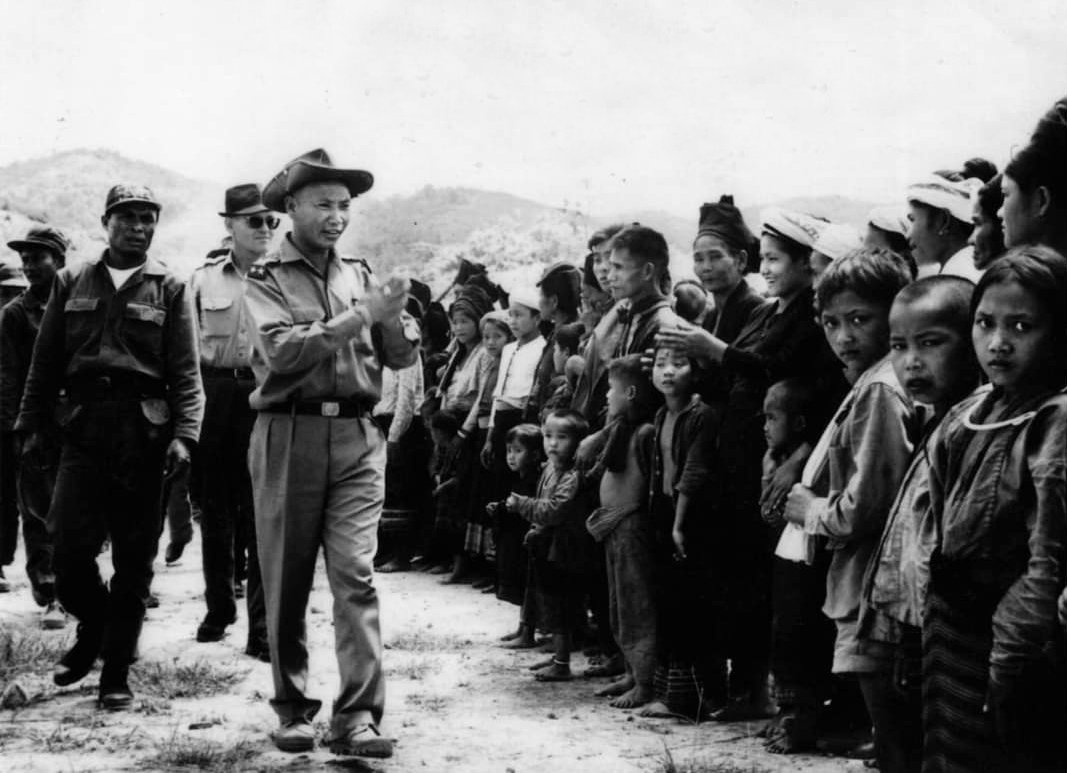
Vang Pao, in front, with Bill Lair (in Raybans) and Thai PARU commander, far left, visited a Thai Dam village in Northern Laos to recruit their men as part of the CIA-backed Secret Army. Early 1965. Lair recruited Vang Pao to join forces with the U.S. in Jan. 1961. (Photo courtesy James W. Lair)
-
CIA operative James W. Lair’ described his first meeting with Lt. Col. Vang Pao in forming a 3-way alliance (U.S., Thai PARU, and Hmong) to fight against the North Vietnamese, January 1961
_________________“We assembled around the table, surrounded by Hmong irregulars, some members of militia units and others simply tribesmen who had followed Vang Pao first to the Plain of Jars and then south to this mountain valley. In the fascinating exchange that followed, I watched and listened as Vang Pao used the event not merely to establish himself with possible foreign patrons but also to inspire and indoctrinate his followers. Despite the admixture of some French vocabulary, I could follow his Lao well enough to appreciate his mesmerizing effect on his audience as he inveighed against the Vietnamese Communists.
“The communists wanted to destroy the Hmong way of life, Vang Pao complained. They were like the Chinese, who had driven the Hmong into Indochina in the first place. In North Vietnam, the Hmong were already being forced to adopt the lowland culture. This forced assimilation was not the worst offense. Vang Pao went on to describe how, in his early days, he had entered Vietnam to help deal with some procedural problem at the border. There, he had seen Hmong women used as slave labor, dragging logs to a sawmill…
“The accident inspired Vang Pao to new rhetorical heights. I had never seen such a spellbinding performance, but, as essential as I knew it to be, charisma does not constitute a program. Vang Pao paused for breath, and I asked what he proposed to do. The answer was simple, ‘Either we fight, or we leave.’ The easier course would be flight across the Mekong into northwestern Laos and Thailand, but that would not guarantee permanent sanctuary from the Vietnamese. Vang Pao wanted to fight. The combative shouts of his audience persuaded me that he was not alone. Vang Pao pointed out that the communists owned only the population centers in Sam Neua and Xieng Khouang Provinces. He named the areas where loyal Hmong, some lightly armed as members of the militia, occupied the highlands. If he had the weapons, Vang Pao insisted, he could raise an army of 10,000 men in Xieng Khouang alone. After what we had seen and heard that day at Ta Viang, both Pranet and I were prepared to believe him.”
Source:
“AN EXCELLENT IDEA!”
Leading Surrogate Warfare in Southeast Asia, 1951–1970
—A Personal Account
James W. “Bill” Lair: As told to Thomas L. Ahern, Jr.
cia.gov
“In our country, we have our own territorial boundary and independence… When another country is trying to invade your country, this is the responsibility of all Lao people to fight and hold our country and territorial boundary. When someone is trying to change your outcome or to invade your country, it is necessary even to fight until the last man.”
— General Vang Pao
Commander of Military Region II
Statement to the Press 1971

Right, Map of Laos. Long Tieng, located near the Plain of Jars, was the Headquarters for the CIA’s Secret War operation and Royal Lao Army’s Military Region II. This region was commanded by Gen. Vang Pao. (Photo courtesy SGU Collection)

GVP Family Collection, 2009.
U.S. military objectives for the Hmong soldiers during the Secret War, a part of the Vietnam War, were:
To defect as many North Vietnamese Army (NVA) soldiers as possible to fight in Laos to relieve more enemy troop pressures entering and fighting against American forces in South Vietnam, and to prevent Laos from falling like a ‘domino’ — also, see Domino Theory.

Wounded American soldiers in South Vietnam. Image from The National Endowment for Humanities.
To rescue American pilots who were shot down by the enemy anti- aircraft guns along the Laos-North Vietnam border; where at times as many as between 100 and 200 Hmong soldiers risked their lives rescuing one downed U.S. pilot.
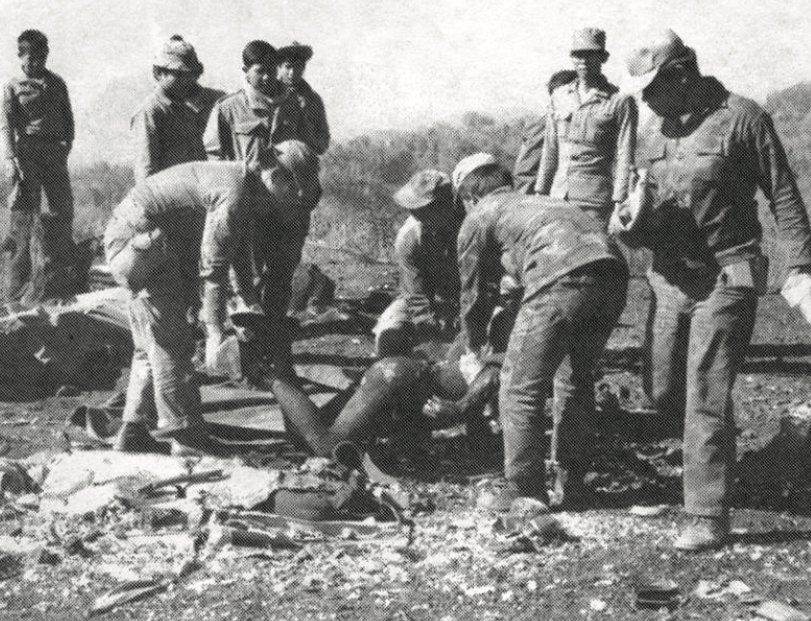
Hmong soldiers recovered the body of an American pilot who was shot down in N. Vietnam and crashed near the Plain of Jars, 1969. Yang See Collection.
To defend and protect the CIA’s TACAN reconnaissance radar installed at Phou Pha Thi, Lima Site 85, that directed precise U.S. bombing missions in Vietnam.

Image of the CIA’s TACAN radar at Phou Pha Thi, Sam Neua Province, Laos. SGU Collection.
To disrupt the Ho Chi Minh trail from the NVA for supplying ammunition and resources to its troops in South Vietnam near the Demilitarized Zone (DMZ).

Map of the Ho Chi Minh Trail, which cut through Northern Laos, then entered into South Vietnam and Cambodia in the south. SGU Collection

The war took a toll on the Hmong population
______________
By 1971, the average age of Hmong soldiers serving in the Secret War was 15, and boys as young as 10 were also recruited into the CIA’s Secret Army.
(Photo courtesy Gary Gentz, Air America)
Air America
______________

Air America played a crucial role for the CIA’s Secret War inside Laos. With the main operation conducted out of Long Cheng, this CIA’s secret airbase was once the “busiest airport in the world”. For Gen. Vang Pao, his soldiers, and the Hmong, the airline was the supply engine for the Hmong’s survival. As the war went on for too long, they could no longer plant or work the fields. They depended on the airline to drop rice.
(Photo courtesy Air America)
Supporting the "Secret War": CIA Air Operations in Laos, 1955-1974
______________
By William M. Leary
Air America, an airline secretly owned by the CIA, was a vital component in the Agency’s operations in Laos. By the summer of 1970, the airline had some two dozen twin-engine transports, another two-dozen short-takeoff-and-landing (STOL) aircraft, and some 30 helicopters dedicated to operations in Laos. There were more than 300 pilots, copilots, flight mechanics, and air-freight specialists flying out of Laos and Thailand…
______________
Laos was the most heavily bombed country per capita in the entire history of modern warfares, with some 2 million tons of bombs dropped inside and along the borders of Laos and Vietnam.
Time lapse of U.S. bombing missions in Laos during the Vietnam War, from 1965-1973. Today, the remaining unexploded bombs still gravely affect many villagers. Mother Jones Collection